
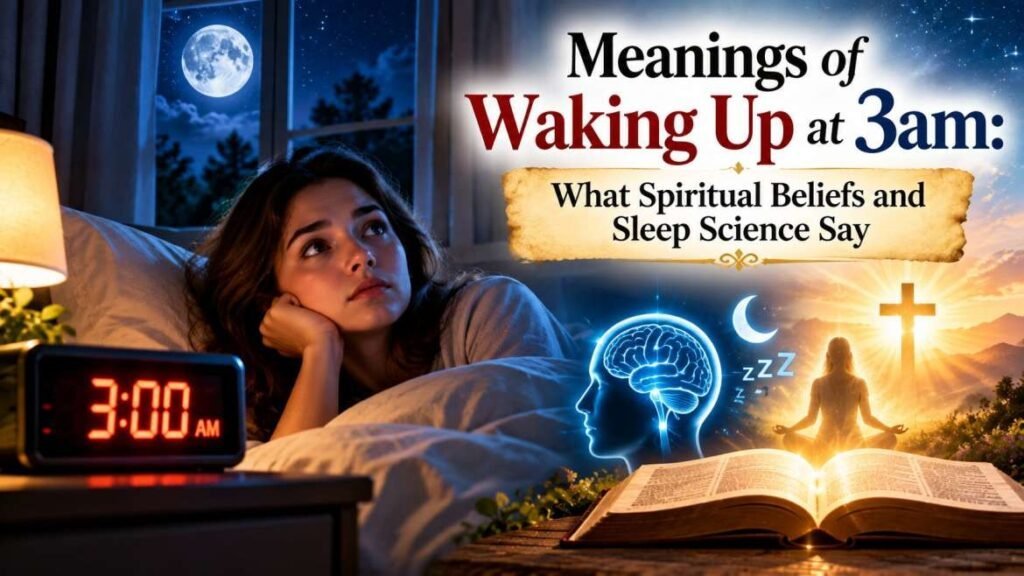
You open your eyes, check the clock, and it’s 3:00 again. The meanings of waking up at 3am depend on who you ask: some traditions see a spiritual message, while sleep researchers point to sleep cycles, stress hormones and your environment. This guide covers both sides, shows where each idea comes from, and helps you work out which explanation fits your nights.
Spiritual Meanings of Waking Up at 3am
None of the following can be proven, but they’re the interpretations people most often describe. Treat them as ways of reflecting, not as facts.
The “Witching Hour” or Thin-Veil Idea
Folklore calls the small hours the “witching hour,” a time when the boundary between the ordinary and the spiritual world is said to be thin. Many modern spiritual writers say waking at 3am means guides, ancestors or your intuition are trying to reach you. This belief comes from folklore and later spiritual writing, not from any scientific or scriptural source.
A Prompt to Pray or Meditate
In many faith traditions, quiet night hours are seen as good for prayer. Some believers treat a 3am wake-up as an invitation to pray for someone else, or simply to be still.
Unprocessed Emotions
Some spiritual and psychological writers say the mind surfaces unresolved worries when distractions are gone. You don’t need to hold any belief about spirits to find that useful: the dark, quiet house is when worries often feel loudest.
A Season of Change
People going through a move, grief, a career shift or a spiritual search often report restless early mornings. In this reading, the wake-up is a symptom of transition, not a message.
Biblical Perspective on Waking Up at 3am
The Bible never mentions 3am. Here is what it does say about night hours:
- Night watches: The Psalms describe praying through the night. One writer says he remembers God “in the watches of the night” (Psalm 63:6), and another says his eyes stay open through them (Psalm 119:148).
- The fourth watch: In the Roman system used in the New Testament, the fourth watch covered roughly 3am to 6am. It’s when Jesus came to the disciples walking on the sea (Matthew 14:25).
- Rest is also a gift: Psalm 127:2 says God gives sleep to those he loves, so broken sleep isn’t automatically a spiritual summons.
You’ll sometimes see claims that 3am is a “demonic hour” because Jesus died around 3pm (Mark 15:34, the ninth hour). Scripture doesn’t make that connection, and it’s best treated as popular tradition.
How the Main Interpretations Compare
| Interpretation | Where the idea comes from | Evidence |
|---|---|---|
| Thin veil / witching hour | Folklore, modern spirituality | None that can be tested |
| Call to prayer | Devotional tradition | Personal experience, not scripture-specific to 3am |
| Emotional processing | Psychology and spiritual practice | Partly supported (stress affects sleep) |
| Natural sleep and hormone rhythm | Sleep research | Well supported |
What Sleep Science Says About 3am Wake-Ups
Early morning is a common time to wake because of how the night is built. As the night goes on, you spend more time in light sleep, and light sleepers wake more easily to noise. Your body clock also begins preparing you to wake: cortisol normally rises in the early morning to help you feel alert, and an earlier spike can pull you out of sleep.
Common contributors include:
- Stress, anxiety or low mood
- Alcohol or caffeine late in the day
- A warm, noisy or bright bedroom
- Needing the toilet
- Hormonal shifts such as perimenopause
- Sleep apnoea or other sleep disorders
The Sleep Foundation’s overview of why you wake up at 3am covers these causes in more detail.
Which Explanation Fits You?
Ask yourself:
- Is it new or ongoing? A one-off is usually nothing; a pattern deserves attention.
- How do you feel on waking? Racing thoughts and a pounding heart point to stress. Calm and alert is a different experience.
- What changed recently? Life events, medication, alcohol, caffeine or schedule changes.
- Do you fall back asleep? Struggling to return to sleep for weeks is worth raising with a doctor.
What to Do When You Wake at 3am
- Keep the room cool, dark and quiet.
- Avoid checking your phone or the clock; clock-watching raises stress.
- If you’re awake for roughly 20 minutes, get up and do something calm in dim light, then return to bed when sleepy.
- Write down any worry that’s circling so your mind can set it down.
- If prayer or meditation is part of your life, use the time that way. It can be comforting whether or not you read the wake-up as a message.
- Cut caffeine after midday and limit evening alcohol.
If wake-ups continue for weeks, leave you exhausted by day, or come with loud snoring, gasping or low mood, speak to a GP or doctor.
Frequently Asked Questions
Is 3am really the witching hour?
“Witching hour” is a folklore term, usually applied to the middle of the night. There’s no scientific basis for 3am being special.
Is waking up at 3am a bad sign?
Usually not. Occasional wake-ups are common, though frequent ones tied to stress or poor sleep are worth addressing.
Why do I wake up at exactly 3am?
Light sleep, early cortisol activity and habit can line up around that time, and checking the clock then reinforces the pattern. Consistent timing may also reflect your routine or environment.
Should I get out of bed?
If you can’t fall asleep within about 20 minutes, getting up for a quiet activity can help break the cycle of frustration.
Can I find spiritual meaning and still treat it as a sleep problem?
Yes. Reflection or prayer can sit alongside better sleep habits and medical advice.
Conclusion
The meanings of waking up at 3am range from sleep-cycle biology and stress hormones to spiritual traditions that see the hour as a time for prayer or reflection. The Bible doesn’t assign 3am any special meaning. The practical takeaway: look at the body and routine first, use the quiet hour in a way that helps you if you find it meaningful, and see a doctor if it persists.
Read more: Short Spiritual Meanings of Right Ear Ringing: 12 Quick Interpretations and When to Get It Checked