
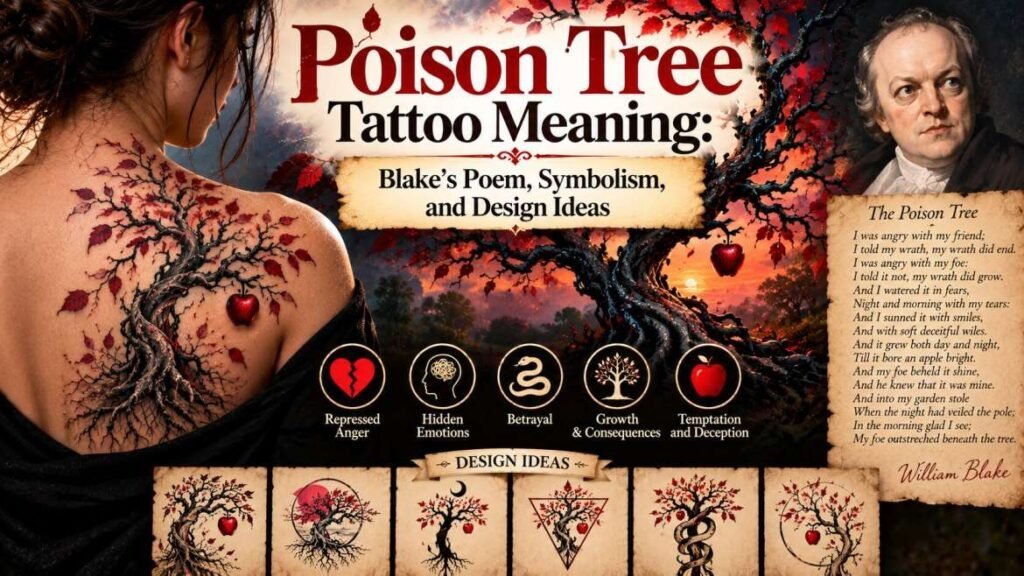
A bare, dark tree might look like a simple gothic design, but the poison tree tattoo meaning is more specific and more personal. It comes from William Blake’s poem “A Poison Tree,” a short piece about what happens when anger is hidden instead of spoken. People get this tattoo to mark toxic relationships, emotional recovery, or a lesson learned the hard way. Here’s where it comes from, what its parts symbolize, and how to make a version that fits your story.
Where the Poison Tree Tattoo Comes From
The design is rooted in William Blake’s 1794 poem “A Poison Tree”, which appears in his collection Songs of Experience. You can read the full poem on the Poetry Foundation.
The poem is only sixteen lines long, in four short stanzas. It tells of a speaker who voices anger at a friend and watches it fade, but hides anger at an enemy. Fed by fear and false smiles, the hidden anger grows into a tree bearing a bright apple. The enemy is drawn to it, and the poem ends with him dead beneath the tree.
Blake’s point is stark: anger you voice can pass, but anger you bury can grow into something that harms.
Poison Tree Tattoo Meaning: Core Symbolism
- Suppressed anger: the central meaning. The tree stands for resentment that was fed in silence.
- Consequences of silence: the damage comes not from the anger but from hiding it.
- Deceptive appearance: the “bright apple” suggests something tempting that conceals harm, which readers often connect to the fruit of Eden.
- Self-awareness: for many wearers the tattoo is a reminder to speak up and not let things fester.
- Healing and growth: the tree also marks the point where someone chose a different path.
Interpretations differ, and Blake scholars debate the poem’s finer details. That ambiguity is part of why the tattoo works as a personal symbol.
Poison Tree vs. Other Tree Tattoos
| Tattoo | Core meaning | Typical look |
|---|---|---|
| Poison tree | Suppressed anger, emotional damage | Dark or bare tree, often a single bright or corrupted fruit |
| Tree of life | Growth, family, connection | Full canopy, balanced roots and branches |
| Dead or bare tree | Loss, endings, winter before renewal | Leafless branches, no fruit |
| Weeping willow | Grief, mourning | Drooping branches |
The poison tree is the only one tied to a specific text and a specific emotion.
Design Elements and What They Suggest
- Single bright apple: the deceptive “fruit” of hidden resentment.
- Twisted or thorny branches: tangled, tightly held emotion.
- Roots visible above or below ground: how deeply the feeling grew.
- Moon or night sky: the secrecy of unspoken anger.
- A single leaf or blossom: growth alongside the darkness.
- Skull or bones: the destructive end of the story.
Styles That Suit the Design
Blackwork gives the heaviest, most dramatic feel. Fine-line is subtler and works at small sizes. Illustrative or engraving styles echo Blake’s own printed illustrations, and dotwork adds a textured, atmospheric look.
Placement Ideas
Forearm, calf, and upper arm give a tall tree room for branches and roots. Ribs and back suit larger pieces, while a small fine-line tree fits behind the ear or on the ankle.
Is a Poison Tree Tattoo Negative?
Not necessarily. On the surface it is about a destructive emotion, but many wearers treat it as a survivor’s mark: proof that they recognized the pattern and changed it. Others get it as a warning to themselves. The meaning depends on whether you present the tree as a wound or as a lesson, and you can signal this through design, for example by adding a new green shoot or a bright flower.
Who Gets a Poison Tree Tattoo?
People tend to choose it after leaving a toxic relationship, working through family conflict, or learning to express anger directly instead of holding it in. Literature fans also choose it as a nod to Romantic poetry. If you’re getting it to commemorate something painful, consider whether you want that to be the dominant image on your skin long term.
[INTERNAL LINK: add a link here to your page on tree tattoos or literary tattoos. Suggested anchor text: “other tree tattoo meanings.”]
Frequently Asked Questions
What does a poison tree tattoo mean?
It symbolizes anger and resentment that grow when left unspoken, based on William Blake’s 1794 poem.
Who wrote “A Poison Tree”?
William Blake, as part of Songs of Experience.
Is the poison tree the same as the tree of life?
No. The tree of life represents growth and connection, while the poison tree represents the harm of hidden emotion.
Can a poison tree tattoo mean healing?
Yes. Many wearers use it to mark recovering from anger or betrayal and choosing honest expression instead.
What style works best for a poison tree tattoo?
Blackwork and illustrative engraving-style designs are popular. Fine-line works well for small versions.
Conclusion
The poison tree tattoo meaning comes straight from Blake’s poem: unspoken anger can grow into something that harms you and others. Whether you wear it as a warning, a record of survival, or a tribute to a favorite poem, the design is most powerful when it reflects your own experience. Choose details that match your story and an artist who can handle the fine line work.
Read also: 444 Tattoo Meaning: Symbolism, Design Ideas, and What to Know Before You Get One