

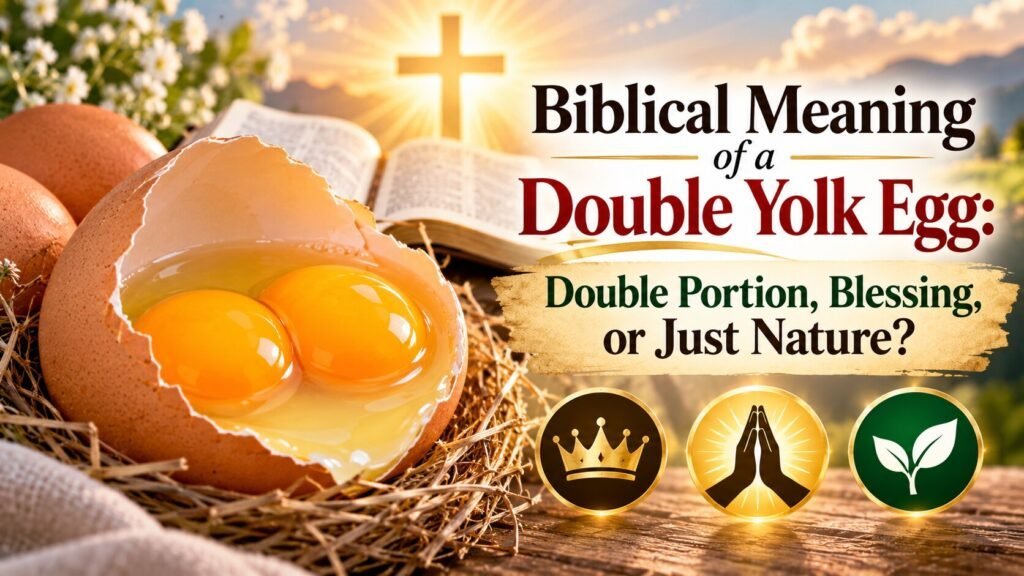
You crack an egg and find two yolks. Is it only a kitchen surprise, or something more? The biblical meaning of a double yolk egg isn’t stated anywhere in Scripture. Most Christian readings draw on the Bible’s “double portion” theme and read the egg as a sign of abundance, provision or gratitude. This article explains why that reading is popular, where it stops being supported, and what is actually happening inside the hen.
What Is the Biblical Meaning of a Double Yolk Egg? A Quick Answer
The Bible never mentions double-yolked eggs. Believers who find meaning in them usually point to three themes:
- Double portion, meaning abundance and favor
- Fertility and new life, often tied to twins
- Unity, meaning two things held in one shell
These are symbolic readings, not teachings. They work best as a prompt for gratitude, not as a prediction.
What Actually Causes a Double Yolk?
The natural explanation is simple. Double-yolk eggs happen when a hen loses control of the mechanism that normally limits her ovary to producing one yolk per ovulation. Two yolks end up wrapped in a single shell.
A few other facts are worth knowing:
- Double yolks are most common in young hens. Pullets, whose reproductive systems are still maturing, are the most likely to lay them.
- Across a whole laying cycle they’re uncommon. A figure of roughly one in a thousand is often quoted, though it varies by flock, breed and age.
- They are safe to eat. They’re larger than normal eggs, and each yolk is smaller than a standard one.
- They rarely produce chicks. Commercial hatcheries don’t incubate them because fertility and hatchability are much lower than for single-yolk eggs.
For a deeper look, the open-access study Analysis of the Quality and Chemical Composition of Double-Yolked Eggs Compared to Those of a Normal Structure covers how often they occur and how they compare nutritionally.
Eggs in the Bible
Eggs appear only a handful of times in Scripture, and never as a symbol of the miraculous:
- Deuteronomy 22:6 gives a law about a bird’s nest with eggs.
- Job 6:6 mentions the white of an egg as a bland food.
- Luke 11:12 has Jesus using an egg in a parable about a father’s good gifts.
The Easter egg as a symbol of resurrection is a later church tradition, not a biblical one. This matters, because many articles claim the Bible treats eggs as signs of new life. It doesn’t. The symbolism comes from Christian custom.
The Double Portion Theme in Scripture
Here is the strongest link between the keyword and the Bible. The idea of “double” shows up repeatedly as a picture of favor, inheritance or restoration:
- Deuteronomy 21:17: the firstborn receives a double portion of the inheritance.
- 2 Kings 2:9: Elisha asks Elijah for a double portion of his spirit.
- Job 42:10: the Lord restores Job’s fortunes and gives him twice what he had before.
- Isaiah 61:7: a double portion replaces shame.
- Zechariah 9:12: God promises to restore double to His people.
A double yolk is a natural visual match for this theme, so it’s easy to see why believers adopt it. Still, nothing in these passages connects the idea to eggs. The link is a modern, devotional one.
Common Interpretations
| Interpretation | Basis | How solid is it? |
|---|---|---|
| Abundance and provision | Double portion passages; Psalm 23:5 | Reasonable as a devotional reflection |
| Twins or fertility | Psalm 127:3 on children as a gift | Folk belief; no link to pregnancy |
| Unity and partnership | Ecclesiastes 4:9–12 | Symbolic only |
| New beginnings | General biblical renewal themes | Symbolic only |
| Warning or bad omen | None | Not supported by Scripture |
Abundance and Overflowing Provision
Psalm 23:5 describes a cup that overflows. A double yolk can serve as a visible reminder that God often gives more than we ask for. Treat it as a reminder, not a guarantee. Scripture promises God’s care, but it doesn’t promise material windfalls.
Twins, Fertility and Family
Some people link two yolks to twins or an expected baby. There is no scientific or biblical basis for this. If you’re hoping for a family, Psalm 127:3 is a fine passage for prayer, but an egg isn’t a pregnancy test.
Unity and Partnership
Ecclesiastes 4:9 says two are better than one. Two yolks sharing one shell can make a sweet picture of marriage, friendship or partnership, but it remains a metaphor.
Is a Double Yolk Egg a Good or Bad Sign?
In faith-based readings, it’s almost always a positive sign. The Bible doesn’t teach that unusual events work as omens, and Deuteronomy 18:10–12 warns against seeking guidance from signs and divination.
A balanced approach is to receive the moment with thanks and avoid building decisions on it. Gratitude costs nothing, while prediction can mislead.
How to Respond Thoughtfully
- Enjoy it. It’s a small, pleasant surprise.
- Say thanks for daily bread, which is a real biblical practice (Matthew 6:11).
- Read one of the “double portion” passages and consider where you’ve been given more than you expected.
- Share it. Cook the eggs for someone else, which fits the generosity theme.
If you enjoy reflecting on everyday objects in this way, you might find [INTERNAL LINK: related biblical symbolism article] a natural next read.
Frequently Asked Questions
Is a double yolk egg mentioned in the Bible?
No. Eggs are mentioned only a few times, and none of the passages describe double yolks.
What does a double yolk egg symbolize spiritually?
Most people link it to abundance, blessing and the idea of a “double portion.” These are symbolic readings, not doctrine.
Is a double yolk egg a sign of pregnancy?
No. There is no evidence connecting double yolks to pregnancy or twins.
Are double yolk eggs safe to eat?
Yes, they’re safe to eat and have a similar nutritional makeup to a larger egg.
Why do I keep finding double yolks in one carton?
Eggs from young hens are more likely to have two yolks, and a carton often comes from one flock. Finding several together is usually explained by that.
Conclusion
The biblical meaning of a double yolk egg is a matter of reflection, not revelation. Scripture is silent on the egg itself, but its repeated “double portion” theme gives believers a natural way to read the moment as a reminder of God’s generosity. Enjoy it, give thanks, and let Scripture rather than the kitchen set the direction of your life.