

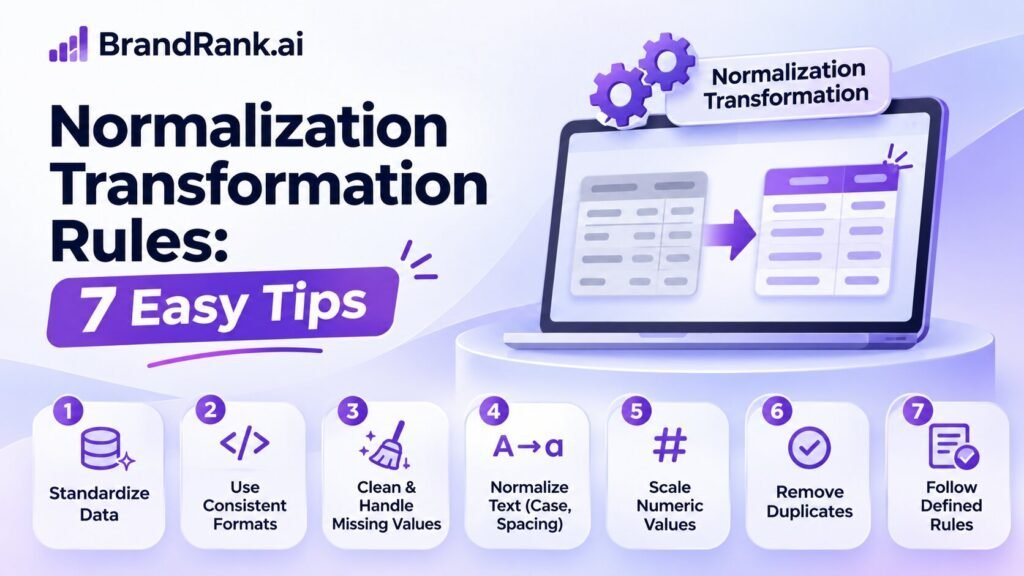
If you searched for BrandRank.ai normalization transformation rules, you have probably seen many articles that present them as an official rulebook. Here is the catch: BrandRank.ai has not published anything under that name. What does exist is a real data practice that helps AI tools recognize your brand as one clear entity. This guide separates fact from filler and gives you 7 easy tips you can use today.
What Are BrandRank.ai Normalization Transformation Rules?
BrandRank.ai normalization transformation rules is a popular label for two steps in brand data work. Normalization cleans names and labels into one consistent format. Transformation reshapes numbers so different metrics can be compared fairly. It is a practical concept, not an official BrandRank.ai specification.
The two steps are often mixed up, so here is a simple comparison.
| Feature | Normalization | Transformation |
|---|---|---|
| Main focus | Consistent names and labels | Shape and scale of numbers |
| Example | “BrandRank AI” and “brandrank.ai” become one entity | Raw mention counts rescaled to a 0 to 100 range |
| Goal | One clean brand record | Fair comparison between brands |
| Main risk | Merging two different brands by mistake | Hiding real differences between them |
Is It an Official BrandRank.ai Framework?
No public page from BrandRank.ai defines a rulebook with this exact name. Several near-identical blog posts describe it as a formal system, but none point to a source from the company itself. That is a good reason to be careful.
What is verifiable is this:
- BrandRank.AI is a Cincinnati-based SaaS platform that tracks how brands appear in AI answer engines such as ChatGPT, Gemini and Perplexity.
- Its core scores cover AI search visibility, vulnerability and content readiness.
- In spring 2026 it announced a partnership with Burke, Inc. to launch a diagnostic called BRAND ANSWER. You can read the details in this Burke and BrandRank.AI press release.
So treat any claim about exact weights or secret formulas as unverified. The ideas behind normalization are still useful, though, because they come from standard data practice. The same checking habit works for any unclear term online: look for a named author, an official source and independent confirmation. Our guide on how to verify claims about an unfamiliar name shows that method step by step.
Why Normalization Matters for AI Search
Traditional search shows ten links. AI assistants often give one combined answer. If your brand appears under five slightly different names, the signals get split, and the AI may treat you as several small entities instead of one strong one.
Clean, consistent data helps in three ways:
- AI systems can connect mentions to the right brand.
- Sentiment from many sources can be grouped properly.
- Reports show true share against competitors, not a messy count.
7 Easy Tips to Apply BrandRank.ai Normalization Transformation Rules
Tip 1: Choose One Canonical Brand Name
Pick a single spelling, including capital letters and punctuation. Use it in your logo text, headings, social bios and press releases. Write it down so everyone on your team uses the same version.
Tip 2: Standardize Domains and Legal Suffixes
Decide which domain version is primary and redirect the others. In analytics, strip suffixes such as LLC or Inc. from matching keys, because they add noise. Keep the full legal name on legal pages where it belongs.
Tip 3: Map Aliases to One Entity
List the common variations of your name, including misspellings, abbreviations and old brand names. Map each one to the canonical record, but keep the original text too. This is entity resolution, not spell-checking, and the original string helps you audit mistakes later.
Tip 4: Keep Profile Data Identical Everywhere
Your About page, social profiles, directory listings and review sites should share the same name, description, address and category. Small differences look minor to people but can look like different entities to machines.
Tip 5: Add Organization Schema
Structured data tells search engines who you are in a machine-readable way. Google explains that organization markup helps describe details like your logo, contact information and official profiles in its Organization structured data announcement. Add it to your home page or About page, and link your official profiles with the sameAs property.
Tip 6: Scale Metrics Before You Combine Them
This is the transformation side. Never add raw numbers from different scales. Rescale them first, then combine.
| Method | Best for | What it does |
|---|---|---|
| Min-max scaling | Simple comparisons | Squeezes values into a fixed range, such as 0 to 1 |
| Z-score | Spotting unusual values | Shows how far a value sits from the average |
| Log transform | Very skewed counts | Reduces the weight of extremely large numbers |
Choose one method per metric and stick with it, so your reports stay comparable over time.
Tip 7: Keep a Rule Log and Review It Often
Brands rebrand, products get renamed and URLs change. Record each rule with a date, a reason and who approved it. A simple log lets you explain why a number changed, and it prevents quiet errors from piling up.
Quick Brand Data Audit Checklist
Use this 30-minute check before you change anything.
| Check | Question to ask | Pass? |
|---|---|---|
| Name | Is the spelling identical on all main platforms? | Yes / No |
| Domain | Do all domain versions redirect to one? | Yes / No |
| Aliases | Are common misspellings mapped to one record? | Yes / No |
| Schema | Is Organization markup live and valid? | Yes / No |
| Metrics | Are numbers scaled before they are combined? | Yes / No |
| Log | Is every rule dated and explained? | Yes / No |
Common Mistakes to Avoid
- Over-merging. Two different brands with similar names should never share one record.
- Deleting raw data. Always keep the original text next to the cleaned version.
- Changing names often. Constant edits confuse both people and machines.
- Copying unsourced rules. If an article gives exact formulas with no official source, do not treat them as proven.
- Treating it as a one-time task. Normalization needs regular review, not a single clean-up.
How to Test Your Results
Pick five questions a customer might ask about your category. Ask them in a few AI assistants once a month. Then note whether your name is spelled correctly, which sources are cited and which competitors appear beside you.
Save the answers in a simple sheet. After a few rounds you will see whether your cleaned-up data is making a real difference. If you use a platform like BrandRank.ai, compare its reports with your own notes, since vendor figures are self-reported.
Frequently Asked Questions
What are BrandRank.ai normalization transformation rules?
They are a common label for cleaning brand data into one format and rescaling metrics for fair comparison. They are not an official BrandRank.ai document.
Does BrandRank.ai publish official normalization rules?
No public page from the company defines rules under this exact name. Its published work centers on AI visibility, vulnerability and content readiness.
What is the difference between normalization and transformation?
Normalization makes names and labels consistent. Transformation changes the scale or shape of numbers so they can be compared.
Does normalization improve AI search visibility?
It can help, because consistent data lets AI systems link mentions to one brand. It is not a guaranteed ranking trick.
Which transformation methods are most common?
Min-max scaling, z-score standardization and log transforms are the usual choices. The right one depends on your data.
How often should I review my brand data rules?
Review them every quarter, and again after any rebrand, domain change or product rename.
Conclusion
BrandRank.ai normalization transformation rules are best understood as a smart habit, not a secret formula. Choose one brand name, map the variations, keep your profiles consistent, add schema, scale your metrics and log every change. These 7 easy tips are simple, free to start and useful no matter which tool you use. Start with the audit checklist today, and test the results in a month.